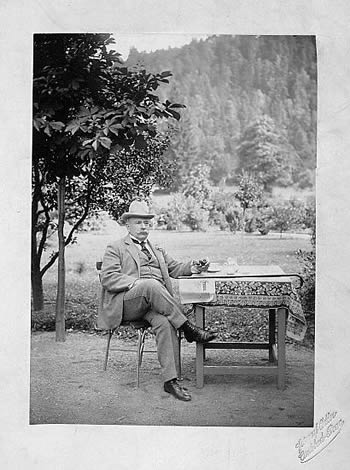
Jules Porgès
(b. 25/05/1839 Vienna, d. 20/09/1921 Paris)
married Rose-Anne WODIANER
"Fotograf Adler, Carlsbad, Prag"
(Courtesy of Comte Michel de la Forest Divonne) |
|
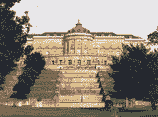
The
Porgès Château at Rochefort en Yvelines (near Paris)
Jules Porgès
built the Château of Rochefort
en Yvelines, in the Paris neighbourhood, for his wife and his daughter.
He and his wife are buried in the Rochefort cemetery.
His death was declared by his grand-son-in-law,
Count Arnaud de Gontaut-Biron.
In the 1980's the property
was transformed by its Japanese owner into a private
golf club.
In the 2010's the castle was transformed into a residential conference center
.
|
|
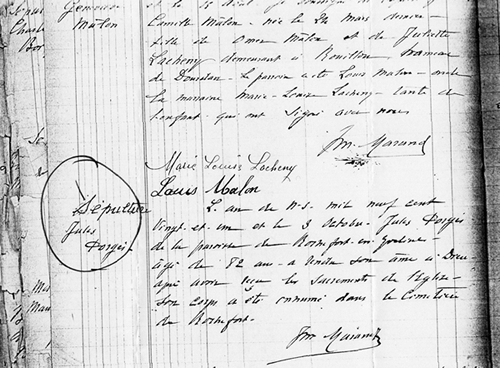
L'an de N.S. mil neuf cent
vingt-et-un et le 9 octobre, Jules Porgès,
de la paroisse de Rochefort-en-Yvelines,
âgé
de 82 ans a rendu son âme à Dieu, après
avoir reçu les sacrements de l'Église.
Son corps a été inhumé dans le
cimetière de Rochefort.
Death register of the
parish of Rochefort. Courtesy of Madeleine Sandrea |
A
dark side .... Jules Porgès and the Dreyfus Affair
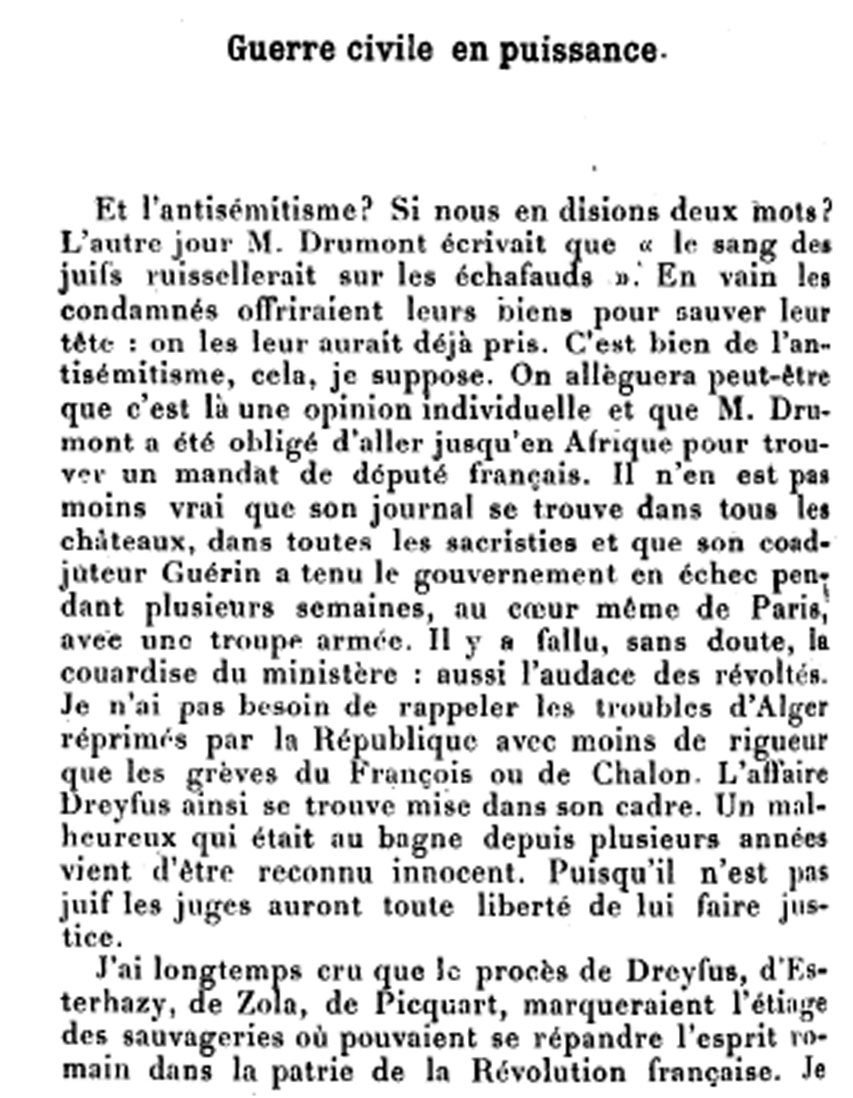
Civil War in the Making
… And antisemitism? Suppose we said a word or two about it?
The other day Mr Drumont wrote that "the blood of the Jews will stream from the scaffolds."
In vain would the condemned offer their possessions to save their heads: their property would already have been taken from them.
That, I suppose, is indeed antisemitism.
It may be objected that this is merely an individual opinion, and that Mr Drumont had to travel all the way to Africa to find a seat as a French deputy.
It is no less true that his newspaper is to be found in every château and in every sacristy, and that his lieutenant Guérin held the government in check for several weeks, at the very heart of Paris, with an armed troop.
This required, no doubt, the cowardice of the ministry — and also the audacity of the rebels.
I need scarcely recall that the disturbances in Algiers were put down by the Republic with less severity than the strikes of the François or of Chalon.
The Dreyfus Affair thus finds itself placed in its proper setting.
An unfortunate man who had been in the penal colony for several years has just been recognised as innocent.
Since he is not Jewish, the judges will be at full liberty to do him justice.
For a long time I believed that the trials of Dreyfus, of Esterhazy, of Zola, of Picquart, would mark the low-water mark of the savagery into which the Roman spirit could spread within the homeland of the French Revolution.
I am no longer at all certain of that today, and there are several reasons for it.
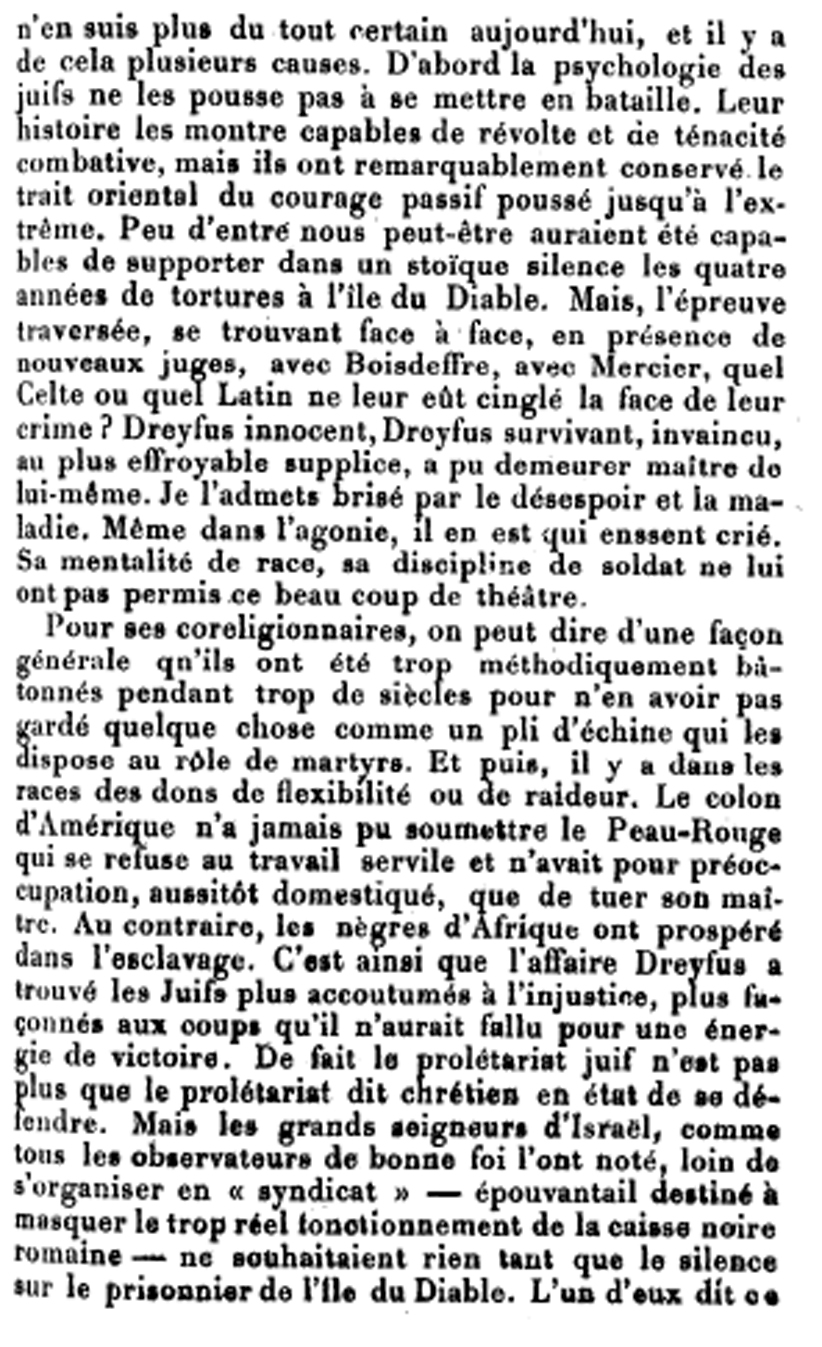
Firstly, the psychology of the Jews does not drive them to do battle.
Their history shows them capable of revolt and of combative tenacity, but they have remarkably preserved the Eastern trait of passive courage carried to its extreme.
Few of us, perhaps, would have been able to endure in stoic silence the four years of torment on Devil's Island.
But once the ordeal had been borne, when he found himself face to face with new judges, with Boisdeffre, with Mercier — what Celt or Latin would not have lashed them in the face with their crime?
An innocent Dreyfus, a surviving Dreyfus, undefeated under the most appalling torture, was able to remain master of himself.
I grant that he was broken by despair and illness.
Even in agony, some men would have cried out.
His racial mentality, his soldier's discipline did not allow him that fine theatrical stroke.
Of his co-religionists, it can be said in general that they have been too methodically beaten for too many centuries not to have kept something like a stoop of the spine that predisposes them to the role of martyrs.
And then, races have their gifts of pliancy or of stiffness.
The American colonist could never subjugate the Red Indian, who refuses servile labour and who, once subdued, had no other thought than to kill his master.
By contrast, the Africans prospered in slavery.
Thus the Dreyfus Affair found the Jews more accustomed to injustice, more shaped by blows than would have been needed for an energy of victory.
In fact the Jewish proletariat is no more capable than the so-called Christian proletariat of defending itself.
But the great lords of Israel, as every honest observer has noted, far from organising themselves into a "syndicate" — that scarecrow meant to mask the all-too-real workings of the Roman slush fund — wished nothing so much as silence on the subject of the prisoner of Devil's Island.
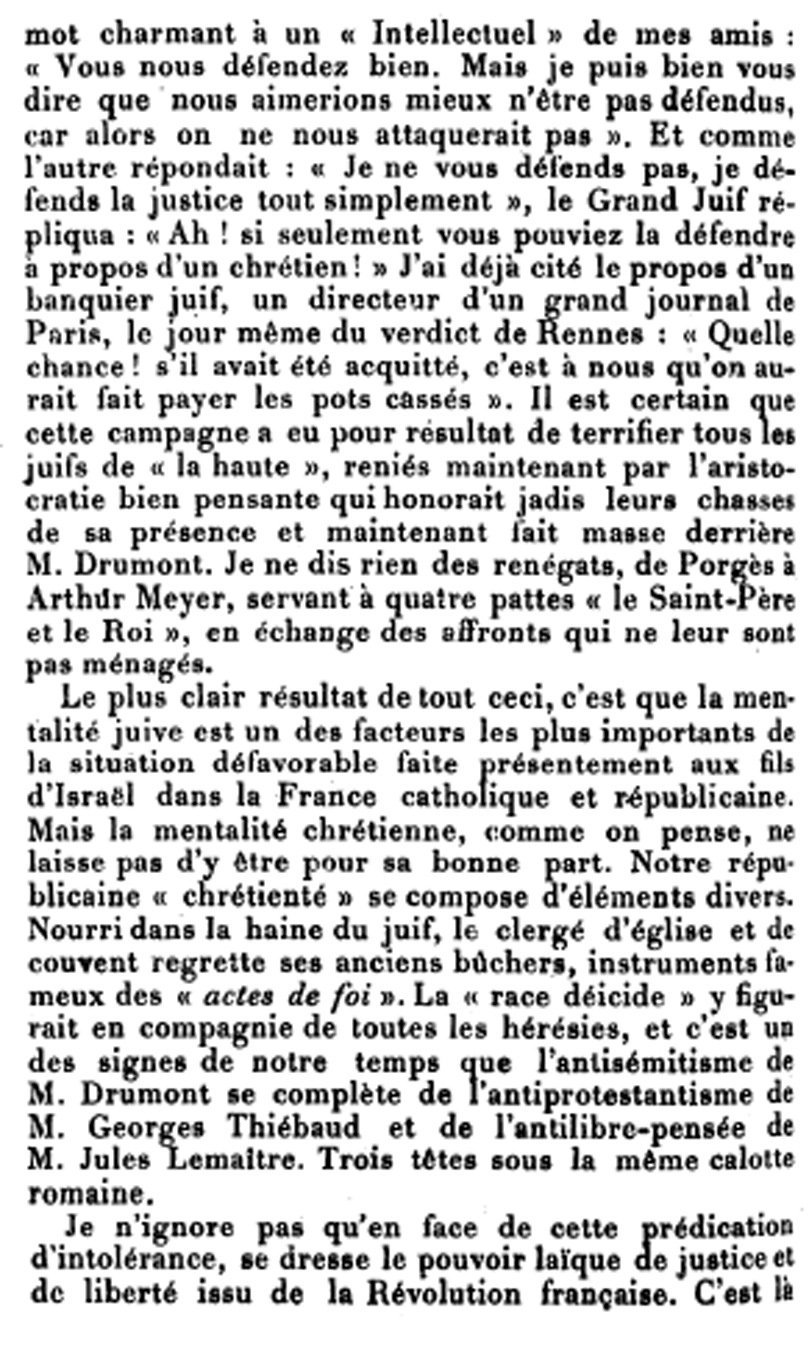
One of them addressed this charming remark to an "Intellectual" of my acquaintance:
"You defend us well. But I may as well tell you that we would much rather not be defended, for then we would not be attacked."
And when the other replied:
"I am not defending you; I am simply defending justice," the Great Jew retorted: "Ah, if only you could defend it on behalf of a Christian!"
I have already quoted the remark of a Jewish banker, the director of a great Paris newspaper, on the very day of the Rennes verdict:
"What good fortune! Had he been acquitted, it is we who would have been made to pay for the broken crockery."
It is certain that this campaign had the effect of terrifying all the Jews of "high society," now disowned by the right-thinking aristocracy that once honoured their hunting parties with its presence and that now closes ranks behind Mr Drumont.
I say nothing of the renegades, from Porgès to Arthur Meyer, who serve on all fours "the Holy Father and the King" in exchange for the affronts that are by no means spared them.
The clearest result of all this is that the Jewish mentality is one of the most important factors in the unfavourable situation now imposed on the sons of Israel in Catholic and republican France.
But the Christian mentality, as one may well think, plays no small part of its own. Our republican "Christendom" is made up of various elements.
Reared in hatred of the Jew, the clergy of church and convent looks back longingly to its old pyres, those famed instruments of the "auto-da-fé."
The "deicide race" figured there in the company of every heresy; and it is a sign of our times that Mr Drumont's antisemitism is rounded out by Mr Georges Thiébaud's anti-Protestantism and by Mr Jules Lemaître's hostility to free thought.
Three heads beneath the same Roman skullcap.
I am well aware that, set against this preaching of intolerance, stands the secular power of justice and liberty born of the French Revolution.
....
Excerpts from La Honte (1903) by Georges
Clémenceau
1899 Affaire Dreyfus. I, L’Iniquité
1899 Affaire Dreyfus. II,Vers la réparation
1900 Affaire Dreyfus. III, Contre la justice
1900 Affaire Dreyfus. IV, Des juges
1901 Affaire Dreyfus. V, Justice militaire
1902 Affaire Dreyfus. VI, Injustice militaire
1903 Discours pour la liberté
1903 Affaire Dreyfus. VII, La Honte
Captain Alfred Dreyfus was the highest-ranking
Jewish artillery officer in the French army.
He was charged
with passing military secrets to the German Embassy in Paris,
and in 1894 was convicted of treason and imprisoned on Devil's
Island.
The conviction was based on documents which were
found in the waste-paper basket of the German military attaché,
Major Max von Schwartzkoppen, and which initially appeared
to the French military authorities to implicate Dreyfus.
Fearing that the sometimes anti-Semitic press would learn
of the affair and accuse the French army of covering up
for a Jewish officer, the French military command pushed
for an early trial and conviction.
By the time they realised
that they had very little evidence against Dreyfus (and
that what they had was not at all conclusive), it was already
politically impossible to withdraw the prosecution without
provoking a political scandal that some feared would have
brought down the French government [citation needed]. The
subsequent court martial was notable for numerous errors
of procedure.
Most notably, the defense was unaware of a
secret dossier which the prosecution provided to the military
judges.
The withholding of this dossier made Dreyfus' trial
illegal under French law.
The dishonourable discharge of
Dreyfus.
L'Aurore's front page on 13 January 1898 features
Emile Zola's open letter to the French President Félix
Faure regarding the Dreyfus Affair.
Alfred Dreyfus was put on trial in 1894 and was accused
of espionage, found guilty and sentenced to life in prison
on Devil's Island.
In June 1899 the case was reopened, following
the uncovering of exonerating evidence, and France's Court
of Cassation overturned his conviction and ordered a new
court martial.
Despite the new evidence presented at his
new military trial, Dreyfus was reconvicted in September
and sentenced to 10 years in prison.
He was subsequently
pardoned by President Émile Loubet and freed, but
would not be formally exonerated until July 12, 1906, when
the Court of Cassation annulled his second conviction.
He was thereafter readmitted to the army and made a knight
in the Legion of Honour.
Dreyfus was recommissioned to serve
behind the lines of the Western Front during World War I
as a Lieutenant-Colonel of Artillery though he did perform
some front-line duties in 1917.
He served his nation with
distinction beyond his natural retirement age.
The Dreyfus
Affair was one of the most important scandals of the French
Third Republic, if not the most important.
The Affair
deeply divided the country into Dreyfusards (those supporting
Dreyfus) and anti-Dreyfusards (those against). Generally
speaking, royalists, conservatives and the Catholic Church
(the "right wing") were anti-dreyfusards while
socialists, republicans and anticlericalists (the "left
wing") were dreyfusards, though there were exceptions.
The Dreyfus Affair could not have happened in
a country wholly antisemitic, nor in a country devoid of
antisemitism.
Indeed, Alfred Dreyfus, openly Jewish, had
been admitted to the most selective military schools in
the country, and had been commissioned into a sensitive
position; this was, at the time, unheard of in several other
European countries, where policies of discrimination were
often in place.
The Affair then greatly split French society
and had important political repercussions; it contributed
to the radicalization of opinion against the Catholic Church
and the "clerical" party, which resulted in the
1905 French law on the separation of Church and State.
The writer Émile Zola is often thought to have exposed
the affair to the general public in a famously incendiary
open letter to which the French statesman and journalist
Georges Clémenceau appended the
eye-catching title "J'accuse!" (I Accuse!); it
was published January 13, 1898 in the newspaper L'Aurore
(The Dawn).
In the words of historian Barbara Tuchman, it
was "one of the great commotions of history."
Zola was convicted of libel and was forced to flee the country.
|
 |
 |
 |
 |
A bright side ....
Henriette de La Ferté-Meun, the daughter of Jules Porgès nominated
in 2005
Juste de France for her righteous actions during WWII
As reported by
Yad Vashem, Henriette Porgès, Marquise de La Ferté-Meun,
has
been nominated in 2005 Juste de France for her righteous
actions during WWII.
LES JUSTES DE FRANCE >
Tous les Justes de France Dossier
n° 10583
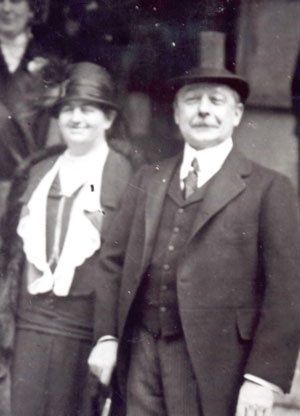
On 25 May 2005, the Yad Vashem Institute in Jerusalem
awarded the Marquise Henriette de la Ferté
and her husband the Marquis Eugène de la Ferté
the title of "Righteous Among the Nations." |
The Marquis Eugène de la Ferté, a landowner, and his wife Henriette came from an old aristocratic family and lived at Mâron (Indre).
Eugène served as the village's mayor.
In 1942, after the Vel' d'Hiv' Round-up, the Halkin couple and their three-year-old daughter decided that Paris was becoming too dangerous for Jews and took refuge at Mâron.
They were joined there by their relatives: four members of the Felzen family; four of the Pinszowski family; and three of the Segal family.
Fourteen people in all.
On their arrival, Eugène de la Ferté and Jules Gilbert — the village schoolteacher and town-hall secretary — granted them refugee status, normally accorded to those evacuated during the military campaign or to the inhabitants of regions annexed by Germany who had opted for France.
This status allowed the refugees to benefit from official assistance.
The Marquis and Jules Gilbert found them lodging, which they fitted out with beds, mattresses, blankets, a wood-burning stove and kitchen utensils.
They saw to it that the refugees received allowances and food vouchers.
The children were enrolled in school, and the Marquise was a great help: thanks to her, they could take their meals at the school canteen.
She also provided them with clothing and shoes.
The Marquis gave Mr Pinszowski a sewing machine so that he could work, and offered Albertine Halkin a secretarial job.
Mr Halkin found employment with local farmers.
The whole village knew where they came from, but no one spoke.
During German incursions, forewarned peasants hid them in the farms or in attics.
The risks run for this aid were enormous, for the regional Militia struck cruelly.
Several relatives of the refugees were massacred not far off, at the Puits de Guéry.
The de la Ferté couple, and Jules Gilbert — who also assisted the Marquis — were people of great kindness and, above all, "did not like the Germans." |
" The Felzen family left Poland for France in 1910.
They
had three children: Albertine, Henri and Pauline.
Mr Felsen
volunteered during the First World War.
In 1920, the family
became French citizens and bought a cafe in 6th arrondissement
of Paris.
In 1941, Albertine was arrested by the police but as a French
national was subsequently released.
Her husband managed to
escape, taking shelter with non-Jewish friends and then fleeing
into non-occupied France.
In 1942, Albertine, aware of the growing threat, abandoned
everything and fled into non-occupied France with her three-year-old
daughter Nicole.
There she rejoined her family in the Indre where they were
sheltered by the Marquis Eugène de la Ferté,
the mayor of the village of Mâron, and his wife.
The couple,
recognizing the Felzens' destitution, found them shelter,
bedding, blankets, food and heating.
The Felzens were not the only family protected by the mayor
and his wife ; they also cared for the Halkin and Pinszowski
families.
Their generosity was unflagging.
At great risk
to their own safety, they not only helped but saved 15 members
of a single family."
Source : http://www.yadvashem-france.org/justes-france/?mode=detail&number=10583
LES JUSTES DE FRANCE > Tous les Justes de France > Dossier
n° 10583
Date de nomination : 2005
DE LA FERTE Eugène (René????) , DE LA FERTE
Henriette
Mâron :Château de Rezay, Indre, Centre
The Felzen family came from Poland to France in 1910.
Three children were born to them: Albertine, Henri and Pauline.
Mr Felzen volunteered for service in 1914–1918.
The family was naturalised as French in 1920 and bought a café in the 6th arrondissement of Paris.
In 1941 Albertine was arrested by the police, then released because she was French.
Her husband managed to escape, to take refuge with non-Jewish friends, and to reach the unoccupied zone.
In 1942 Albertine, sensing the danger growing, abandoned everything to leave with her three-year-old daughter Nicole for the unoccupied zone.
She joined her family in the Indre. They were taken in by the Marquis Eugène de la Ferté, mayor of the village of Mâron, and his wife.
Seeing their destitution, they provided them with lodging, beds, blankets, food and a stove.
The Felzen family was not the only one sheltered by the mayor and his wife. There were also the Halkin and Pinszowski families.
Their generosity was tireless. They saved and helped 15 people from the same family, at the risk of their own lives.
Read also : Marquise Elly de La Ferté-Meun : Juste parmi les Nations http://www.ajpn.org/juste-Elly-de-la-Ferte-Meun-795.html |
Another
side of Mme Porgès social and private
life
|
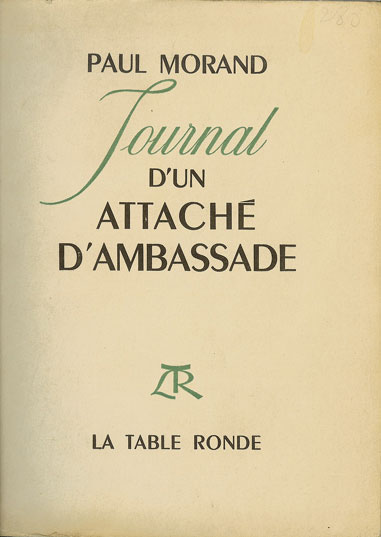
Paul Morand
Journal d'un Attaché d'Ambassade
(1916 - 1917)
La Table Ronde (Paris)
|
|
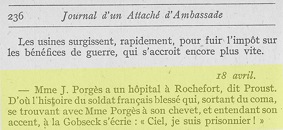
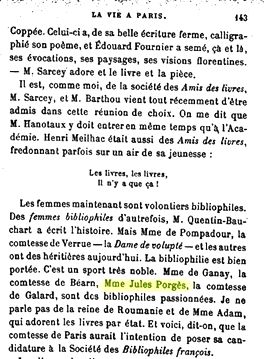
Madame J. Porgès has a hospital in Rochefort, according
to Proust who tells the following story:
"A wounded French soldier,
coming out of a coma, found Mme Porgès standing at his
bedside; upon hearing her accent like some German Shylock,
he cried out, "Oh God, I've been taken prisoner!"" |
|
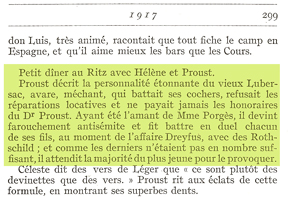
A small dinner at the Ritz with Hélène and
Proust.
Proust describes the startling personality of old Lubersac,
greedy, mean, who beat his coachmen, refused to repair his
rental properties and never paid for the services of Dr. Proust.
Having been the lover
of Mme. Porgès, Lubersac became
fiercely anti-Semitic and forced each of his sons to fight
a duel with one or another of the Rothschilds at the time of
the Dreyfus affair; as there weren't enough of these latter,
he had to wait for the youngest of them to attain his majority
so he could challenge him. |
|
Biographies
of Jules Porgès
|
Jules
Porgès (1839-1921)
 |
Mining
magnate. Born in Prague, settled in Paris in the 1860s
and became a leading diamond merchant.
Both Alfred Beit and Sir Julius Wernher worked for him
and were sent by him to Kimberley.
He himself arrived there in 1875 and became a successful
operator in shares, claims and stones, later extending
operations (establishing the firm of H. Eckstein) to
the Witwatersrand in 1887.
In 1880 he returned to Europe. He retired from business
in 1889, but long outlived both Beit and Wernher. |
|
|
Sir Julius Charles WERNHER
(1850-1912) 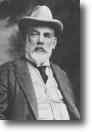
Mining magnate.
Born in Darmstadt, Germany, where his father was attached
to the Grand-Ducal court, he entered a London bank as
a learner, served in the Prussian cavalry in the Franco-German
War of 1870-1871, and, like Alfred Beit, took a post
in Paris with Jules Porgès. Porgès
sent him to Kimberley, where he was elected to the Mining
Board and soon gained wealth and prominence. After the
discovery of the Rand he extended his operations to
the Transvaal. In 1888 he became one of the four original
'Life Governers' of De Beers Consolidated Mines. He
settled in London as Porgès' partner and,
when the latter retired in 1889, continued operations
under the name of Wernher, Beit and Co., the largest
mining house in South Africa, if not in the world, controlling
the Rand Mines group and other huge interests. Apart
from occasional visits to South Africa, he spent the
rest of his life in England. A noted art collector,
he died, leaving the largest South African fortune on
record - over £11,000,000. |
Alfred BEIT (1853-1906) 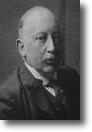
Capitalist and co-founder with Cecil
Rhodes of Southern Rhodesia.
Born in Hamburg in the same year as Rhodes, of an old
Jewish family. He learnt the diamond trade under Jules
Porgès in Amsterdam and elsewhere. In 1875
he went to Port Elizabeth on behalf of his cousins,
the Lipperts, who sent him to Kimberley as their representative.
There he came into touch with Julius Wernher and with
Cecil Rhodes. Attaining considerable prosperity as a
diamond merchant, he became a member of the firm of
Jules Porgès and Co., and on the retirement
of Porgès, he and Wernher converted this
firm in 1884 to Wernher, Beit and Co. Returning to England
he joined forces with Rhodes in his efforts to amalgamate
the diamond mines, which resulted in the foundation
of De Beers. A Life Governor of De Beers, he was one
of the principal figures in the foundation of the Chartered
Company and in the first efforts to open up Rhodesia.
Wernher, Beit and Co. presently became leaders in Barberton
and then in the Witwatersrand gold industry. Beit visited
Rhodesia in the very early days, but kept his headquarters
in London. Unlike Rhodes, he did his utmost to keep
out of politics, though his friendship with him remained
undiminished, and he was one of the main trustees and
heirs under his will. Upon Alfred Beit's death the Beit
Trust came into existence. He also bequeathed enormous
sums for university education and research in South
Africa, Rhodesia, Britain and Germany. |

Große
Jüdische National-Biographie (S. Wininger) :
" He came to Paris
in the 1860's and played a prominent role in the emerging
South-African mining industry . He became one of the first
mining tycoons, with Rhodes and Wernher-Beit .
Even as a naturalized French, he provided a lot of help to
the Austrians much before the war. His Palace in Paris was
the center of the fashionable Parisian Life. His wife, born
Wodianer, assisted him in the achievement of their social
obligations with an exceptional kindness. Mrs. Anna Porgès
was the sister of Mrs. Ida Gutmann, widow of the industrialist
Wilhelm v. Gutmann and Mrs. Pringsheim of Berlin.
Jules Porgès was one of the most eminent art collectors
in Paris. He was an exceptional expert in Dutch art masterpieces,
which were represented, in his gallery of avenue Montaigne,
by the beautiful and rare paintings of van Dyck, Franz Hals
and Ruysdael. "
(Neue Freie Preß. 4 Oct 1921)
Dictionary
of South African Bibliography ( Vol. II, Pretoria, 1983)
:
"
Diamond merchant and mining entrepreneur, was of Jewish parentage
and brought up in Prague, where his father was a master jeweller.
During the 1860's, he settled in Paris, changed his name Julius
(originally Yehuda) to Jules and quickly amassed a fortune
as a diamond merchant.
At the time of the Kimberley discoveries, Jules Porgès
& Co, was the greatest and wealthiest diamond firm in
the world, with a large stake in the diamond-cutting trade
of Amsterdam.
Porgès was quick to recognize that the output from the
Griqualand West mines would transform the whole nature and
scale of the world market in precious stones, in 1873 sent
Alfred Beit and Julius Wernher to South Africa as the firm's
representatives, with instructions to report regularly on
new discoveries.
Three years later, Porgès himself arrived in Kimberley,
immediately becoming a major figure in the local gem stone
market as well as in the buying and selling of digger's claims.
He thus played the complex, double role of producer and merchant
of diamonds.
At first, his interests extended to all four of the principal
mines (De Beers, Bultfontein, Dutoitspan, and Kimberley),
but by 1879 he had come to concentrate increasingly on the
Kimberley mine, setting up a subsidiary to control it, the
Compagnie Française de Diamant du Cap de Bonne Espérance,
which had an initial capital of fourteen million francs divided
in 500 francs shares.
Within two years, the French company was paying out dividends
of eighty francs per share.
Through Beit, Porgès became a close business associate
of C.J. Rhodes, who eventually induced him to persuade the
French shareholders to dispose of their interests to the new
De Beers combine.
In this way, Porgès became a leading figure in the
amalgamation movement, which culminated in August 1887, when
a syndicate, formed by the Rothschilds, advanced the sum of
£1,400,000 for the purchase of the French shares.
Porgès was related to Rudolphe Kann, a famous financier
of Paris, and through him succeeded in interesting the Rothschilds,
who provided the capital that Rhodes needed to buy Kimberley
Central shares.
Though Beit is usually credited with raising money that brought
Barney Barnato to terms, it was in fact Porgès who
was responsible.
Meanwhile, Porgès had returned to Europe in 1880, but
revisited South Africa after the opening-up of the Witwatersrand
gold fields.
In association with Beit and Wernher, but also making much
use of the services of Hermann Eckstein and Eduard Lippert,
Porgès acquired stakes in many mining properties in
and around Johannesburg.
He also was the founder of the famous mining and financial
group known as the 'Corner House' (their offices were erected
on a corner at the site of Market Square, Johannesburg).
In 1890, he retired from South African business, most of his
widespread interests being taken over by the newly established
firm of Wernher, Beit & Co.
Porgès was a man of great elegance and charm and also
one of the shrewdest of businessmen.
He shunned publicity and there were no announcements of his
retirement, or farewell speeches.
South African history scarcely mentions him, and there is
no biography or painted portrait of him.
Yet he had a profound influence on the affairs of the Transvaal
Republic and was the founder of the firm which eventually
became the Central Mining & Investment Corporation of
London and Johannesburg.
A photograph of him appears in Cartwright (infra).
P. H. EMDEN, Randlords,
London, 1935; - A.P. CARTWRIGHT, The Corner House : the early
history of Johannesburg. Jbg 1965 |
Grand
Dukes and Diamonds
The
Wehrners of Luton Hoo
|
By Raleigh Trevelyan
Secker & Warburg, London
1991
© Raleigh Trevelyan
To
read extensive excerpts of the book, click
here.
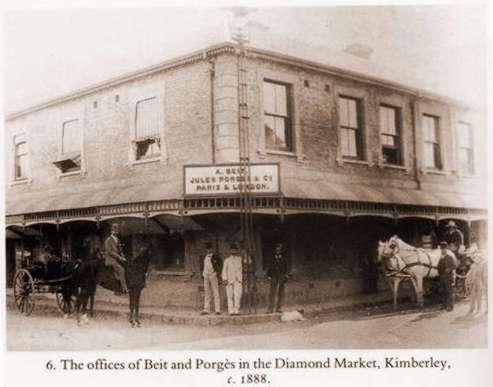
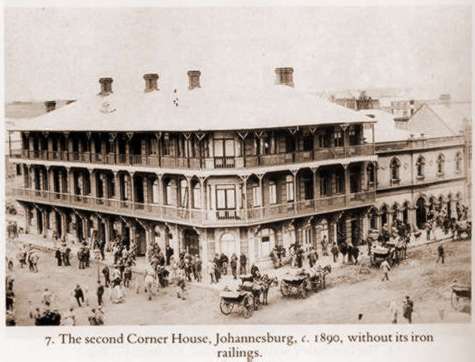
|
The Porges diamond
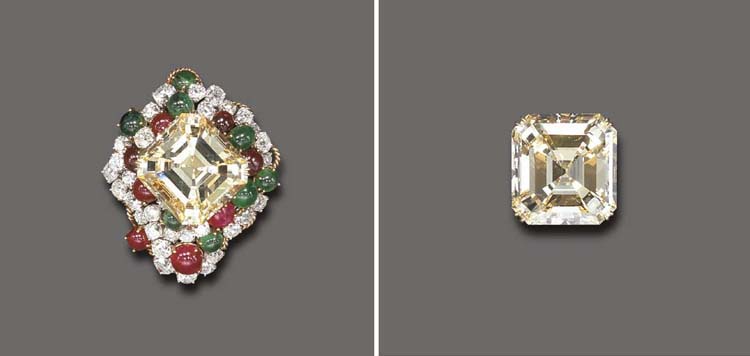
The Porges Diamond is a Fancy Yellow diamond weighing 78.53 carats and was bought by Harry Winston in 1962 who named it, as a tribute to the French diamond mining pioneer, Jules Porges.
Winston mounted the stone so that it may be worn either as a brooch, within a frame set with cabochon-cut emeralds and rubies or as a single stone, set within a simple ring mount.
The current owner purchased it from Harry Winston directly in 1968 and as record books indicate, the whereabouts were unknown until now.
Jules Porges (1839-1921), descended from a prominent Austro-Hungarian family, was born in Vienna and was raised in Prague, where his father was a master jeweler.
By the 1860s he had settled in Paris where he quickly established himself as a principal force in the diamond trade and founded Jules Porges & Company.
Just outside Paris, he built a spectacular château in Rochefort-en-Yvelines for his wife and daughter and his residence in Paris was located on the Avenue Montaigne, where he housed an important art collection, focusing on Dutch masters such as Hals and van Dyck.
By the time diamonds were discovered in South Africa, he had amassed a tremendous fortune and was considered the leading diamond merchant in the world.
Quickly realizing the potential of these newly discovered mines, he dispatched Alfred Beit and Julius Wernher in 1873 to act as his representatives in this new venture and in 1876, Porges himself arrived in Kimberley, playing the unusual role as both consumer and producer of diamonds.
Although he had invested in the mining rights of the four major mines (De Beers, Bultfontein, Dutoitspan, and Kimberley), by 1879 he was almost completely focused on Kimberley and had become a close associate of Cecil Rhodes.
Rhodes eventually convinced the French investors to sell their shares to the newly formed De Beers firm.
Jules Porges quietly retired in 1890.
The Porges is an Asscher-cut Fancy Yellow diamond, SI1 clarity, and it figured as Christie's Magnificent Jewels sale of April 19th and 20th, 2004.
It was Lot 473 in Sale 1362, with an estimate of $600,000 to $800,000 US (sold $769.100 US).
The brooch in the photo, created by Harry Winston, is set with Old Mine and Old European cut diamonds in a freeform design around the Porges itself.
These are enhanced by scattered cabochon-cut rubies and emerald with a total approximate weight of 23.90 and 15.00 carats, respectively.
They are mounted in platinum and yellow gold.
According to the text of the auction the piece is accompanied by a gold ring mounting and a screwdriver to transfer the Porges Diamond back and forth.
Also included was a Harry Winston black suede case.
http://famousdiamonds.tripod.com/porgesdiamond.html
|
About
the social life of Jules Porgès and his wife in Paris
Source
: Emmanuel Mollot, Rochefort-en-Yvelines (2000)
 |
....
I have already told what the soirées of the Austro-Hungarian Embassy were like before 1914, when, in the drawing rooms of the Hôtel Matignon, the most brilliant cavaliers set spinning to the rhythm of the waltz the prettiest women of Paris — and a few heads with them.
No celebration was complete without the Prince of Hohenlohe, the Counts Nemès, Festetics, Tarnowski, Schönborn, Baron Léon de Vaux, Baron Oscar de Gautsch, and Rodolphe de Mittag — an irresistible waltzer who had stolen the heart of one of our great ladies.
The Embassy had in Paris a veritable unofficial annex: the Hôtel Porgès, on the avenue Montaigne. Mme Jules Porgès, who was Viennese, had had built this vast mansion of majestic bearing and uncertain style, whose drawing rooms — as full of old master paintings as the galleries of a museum — served as the setting for many a celebration. She also owned, at Rochefort-en-Yvelines, a comfortable château, sumptuous in the manner of a grand hotel.
Count Khevenhüller, the Austro-Hungarian ambassador, Baron de Vaux, and the secretaries of the Embassy were quite at home on the avenue Montaigne, as was Count Chevreau, whose town house on the rue Monsieur has since become the property of Mme Georges Menier (it is the former mansion of the Count of Jarnac, built on the site of a convent of the Barnabites…).
A brilliant conversationalist, Urbain Chevreau was descended from a minister of Napoleon III, and also from that curious personage who served as secretary of orders to Queen Christina of Sweden and who arranged the marriage of Monsieur, brother of Louis XIV, to Princess Charlotte-Elisabeth.
He made frequent stays in Lausanne, the "Babel of the Gotha," from where he would often send me long letters full of all the gossip of the day.
The Hôtel Porgès had been bought before the war by a company, and the Germans installed themselves there on their arrival in Paris.
In the garden they erected a colossal blockhouse barely lower than the mansion itself, and which has been given up on as too difficult to blow up.
That concrete boulder is beginning, thanks to mosses and lichens, to take on something of a patina.
In the aftermath of the war, Austria, which no longer had an embassy in Paris, acquired a town house on the rue Beaujon for its Legation.
In March 1937 the minister, M. Vollgrüber, gave there a reception in honour of M. Ernst Buschbeck, curator of the Czernin Gallery in Vienna, who had come to give a talk on the Exhibition of Austrian Art at the Jeu de Paume.
M. Vollgrüber left us to become Secretary-General of the Ministry of Foreign Affairs in Vienna.
M. H. D. Schmid, who had been the collaborator of his predecessor at the Legation….
(André
de Fouquières, 50 ans de panache, Éditions
Pierre Horay, p. 314-315) |
|
 |
… in which the most famous actors of the day took part: Got, Samson, Geoffroy, Madeleine Brohan, Mme Favart.
The guests had received programmes bearing the heading: Theatre of Pompeii, reopening after 1,800 years of closure for repairs…
After his marriage to Princess Clotilde of Italy, the son of King Jérôme sold his Pompeian House. No one was found to take on this thoroughly … imperial fantasy: the central "impluvium" served for a time as the basin of a man with performing seals, and the gawkers trod over the flagstones where the ladies of the Court had once danced their first waltzes, swaying their crinolines.
Then, in 1891 — the very year in which "Plon-Plon" (as the Prince was familiarly known) departed this world in a hotel in Milan — the palace was demolished.
A few remnants, judged worthy of preservation, were transported to the Hôtel de Sully on the rue Saint-Antoine.
The banker Jules Porgès later commissioned from Samson — the architect favoured at the time by high society — the mansion that was to replace the Pompeian House.
A mansion still to be seen today, but disfigured by the blockhouse the Germans erected there during the Occupation.
Impregnable, that enormous concrete monster could not have been dynamited without endangering the neighbouring residences.
The Hôtel Porgès enjoyed a brilliant period. The lady of the house gave sumptuous celebrations, receiving her guests with infinite graciousness at the top of the magnificent marble staircase.
Everything unfolded according to the rites of a rather pompous ceremony, but whatever these gatherings might have had of the solemn was joyously enlivened by the presence of the ambassador of the Dual Monarchy, Count Khevenhüller — a regular and most charming guest of Mme Porgès — by the young Austro-Hungarian diplomats, all of them incomparable waltzers, and by the family's Spanish friend, the Count of Casa-Sedano, who brought there his good humour and high spirits.
In the course of one of these soirées I led the cotillon with Mme Porgès's daughter, the Marquise de La Ferté-Meun.
After the death of Mme Porgès, the mansion was sold; then came the war.
At the same time as they occupied No. 18, the Germans also installed themselves at No. 20, in the mansion of Mme Edgar Stern, who had assembled there a fine collection of Louis XVI objects and furniture.
Everything was looted.
After the armistice, among the works of art stolen from Mme E. Stern that could be recovered there was found a bust of Sophie Arnould by Houdon.
As a token of gratitude for their recovered treasures, Mme Stern and her children gave it to the Louvre Museum.
Today, these two residences at Nos. 18 and 20 are the property of the Société des Glaces de Saint-Gobain.
(André
de Fouquières, Mon Paris et ses Parisiens,
Éditions Pierre Horay, p. 84-85) |
|
|
|
|