|
|
|
|
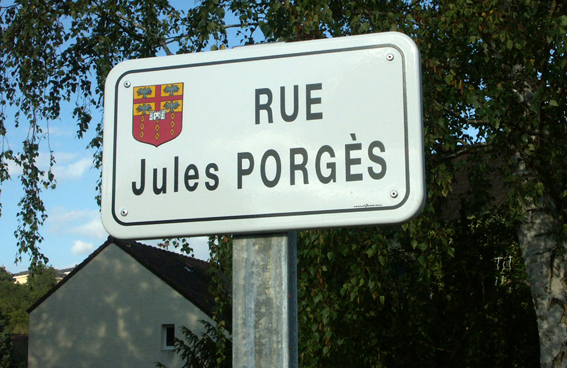
In
February 2006, the City Council of Rochefort en Yvelines
named a street of the village after Jules Porgès
(Source : Emmanuel Mollot, 2007)
The
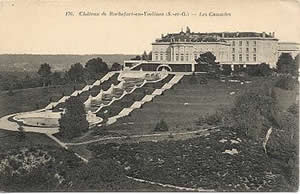
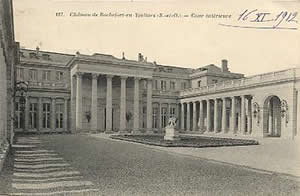
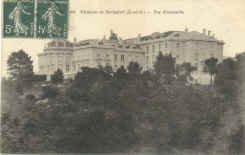
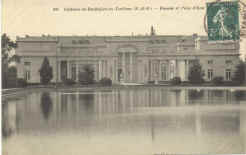
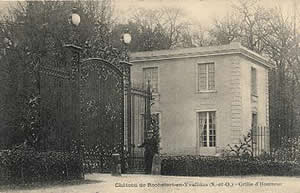
Porgès Château
at Rochefort en Yvelines (near Paris)
Jules
Porgès built
the Château of Rochefort en Yvelines, in
the Paris neighborhood, for his wife and his daughter.
He and his wife are buried in the Rochefort cemetery.
The register of the town hall of Rochefort mentions
that his death was declared by his grand-son-in-law,
Count Arnaud de Gontaut-Biron.
In the 1980's the
property was transformed by its Japanese owner
into a private golf club and a part of the castle
is used as a clubhouse.
Photo credits : Vincent Bouvet
(Paris, 2002)
|
https://fr.wikipedia.org/wiki/Ch%C3%A2teau_Porg%C3%A8s_de_Rochefort-en-Yvelines
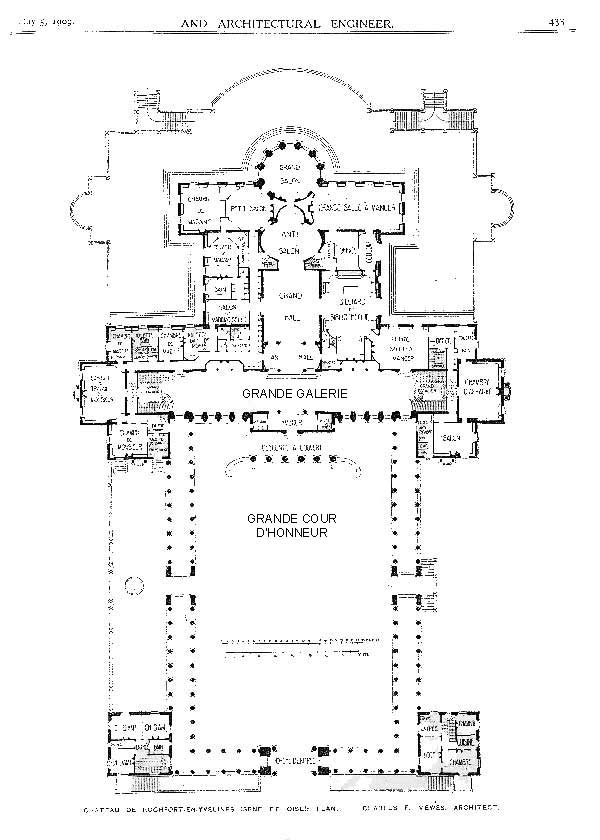
In 1898, Jules Porgès, a renowned diamond merchant of Austrian origin, bought the estate and decided to give his wife, Rose Anna Wodianer, a sumptuous replica of the Hôtel de Salm-Kyrbourg — today the Palais de la Légion d'honneur in Paris — but with certain proportions doubled1.
The first stone was laid on 5 July 1899 at 11:30 a.m., and the last five years later, in 1904.
The work was entrusted to men who left their mark on the history of architecture and decorative art: Charles Mewes, Georges Hoentschel, Paul Cottancin, Émile Devilette…
The best in their fields, or those soon to be, who — having served a year earlier under César Ritz on the Place Vendôme in Paris — set themselves to satisfying the demands of their immensely wealthy patrons, emblematic figures of the Parisian aristocracy.
In fact, the building is probably the most audacious ever constructed in Île-de-France between the two wars (1870–1914).
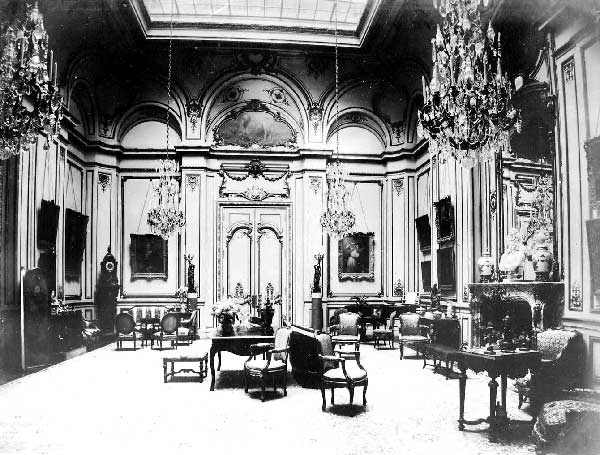
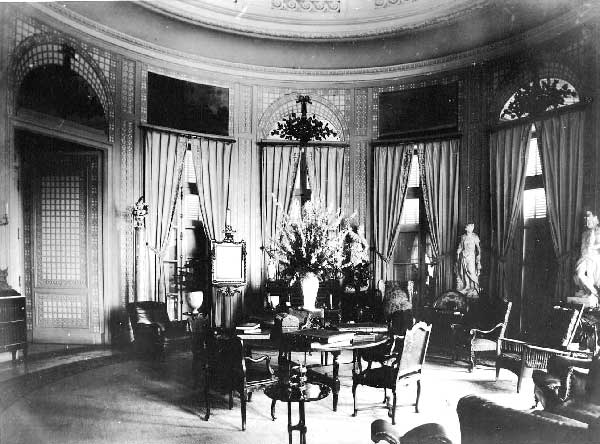
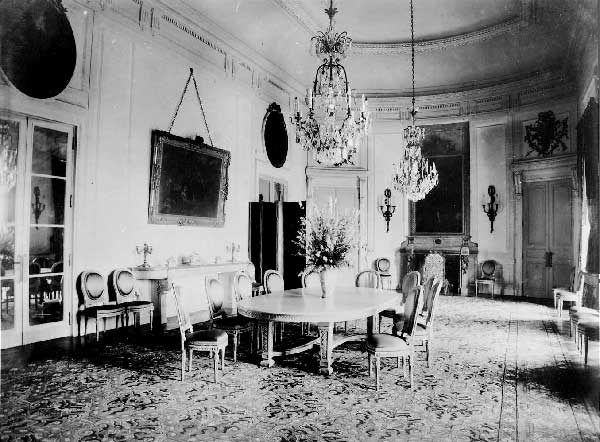
The interiors of the Château — the Grand Dining Room, the Grand Gallery, the Grand Hall (called Louis XV or the Gilded Hall), the ceremonial staircase — feature numerous elements copied from the remarkable buildings of the 17th and 18th centuries.
The models, references for many apprentice decorators, are still to be seen in Paris or abroad (at the Metropolitan Museum of Art in New York).
The château thus symbolises "the art of the copy" that was in vogue among the worldly elite of that era.
The landscape architect Verharghe designed the gardens, the one-hectare ornamental pond and the château's waterfall, while his colleague, the artist Ferdinand Faivre, populated the park with his decorative sculptures.
Madame Porgès, having a strongly pronounced taste for 18th-century creations, turned her neoclassical château into a veritable museum where guests could admire at leisure numerous paintings, rare pieces of furniture, bronzes, and other lacework and ivories.
For ten years, the entire surrounding population flocked to the lavish receptions hosted by the couple.
But in 1914 war broke out, and the château became a hospital.
Jules Porgès died in 1921 and was buried in the Rochefort cemetery, behind the church where the lords of Rohan and of Bernis were also buried.
In 1924, Madame Porgès sold the 800-hectare estate to Jean-Léopold Duplan, a silk manufacturer who had made his fortune in the United States.
He split the whole into two parts in the form of two property companies: Rochefort Foncière, which encompassed the châteaux within their current park, and the Société du Domaine de Tourelle, which covered the rest of the vast property.
It was not until 1940 that the châteaux found a new owner, Monsieur Chatard, who took over the Rochefort Foncière company.
The château was occupied only very briefly by the Germans before the Americans installed 4,000 men there, who remained until 1945.
Monsieur Chatard, during his lifetime, never ceased to restore the collapsed lanes of Rochefort, the buildings, the present château and the ancient ruins, and to maintain the gardens and the ornamental ponds – he died in 1955.
In the Rochefort archives, one may read this: « A few years later, the Rochefort Foncière company once again passed into other hands, but to what fate? People wondered with a touch of anxiety (…) To what use would the two surviving châteaux be put?
In 1964, the château was the principal filming location for Yoyo, a film by Pierre Étaix. In 1966, scenes from the musical comedy Anna by Pierre Koralnik were also filmed there.
We now know that nothing will be destroyed… and that this landscape has found its modern vocation », in the words of Andrée Madeleine Duchet.
Indeed, in 1961, Monsieur Chamley bought the estate and decided to create a golf course there, which was itself bought in 2002 by the Albatros company, which became the new owner of the Rochefort château and golf course.
Since 2008, the Château Porgès of Rochefort-en-Yvelines has been dedicated to hosting corporate seminars. It was acquired, along with the golf course, in June 2016 by the SCPI "Foncia Pierre Rendement" for the sum of €15,050,000. |
Renovation of the Castle (2007) |
|
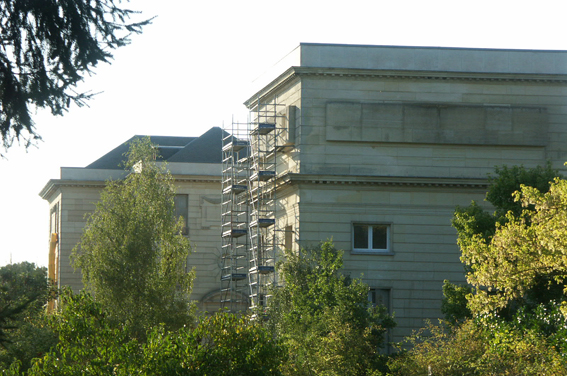 |
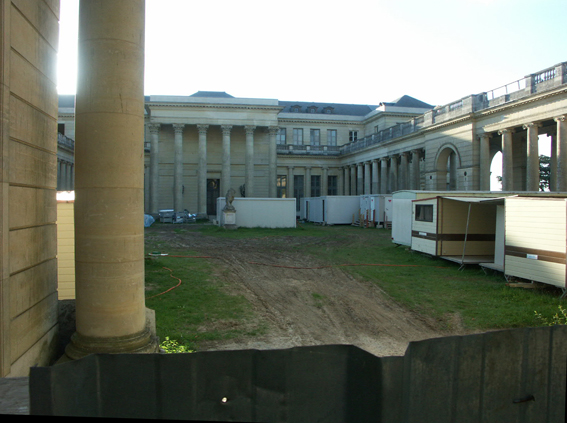
In 2007,
the new owner underwent a complete
renovation of the castle to convert it into
a conference center.
(Source : Emmanuel Mollot)
|
|
|
The
residence of Jules Porgès in Paris
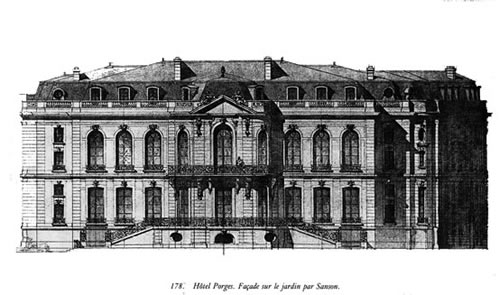
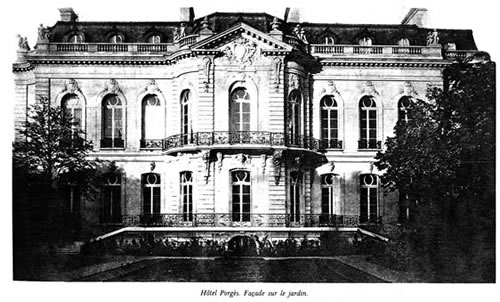
Hôtel
Porgès
14 à 18, avenue Montaigne - Paris
(Gérard
Rousset-Charmy : Les palais Parisiens de la Belle Époque
Éd. : Délégation artistique de
la ville de Paris)
In the Alma district, specifically on the rue Jean Goujon, the Orléans, Ganay, du Lau, Rothschild and Lesseps families owned residences.
Nearby, the avenue Montaigne — previously laid out across open fields, and which the marquis de Marigny had had planted with a double row of elms — was lined with handsome houses during the second half of the 19th century.
At no. 22 along this thoroughfare, Abd el-Kader had lived in the Moorish pavilion that belonged to Ferdinand de Lesseps.
For his part, the son of Jérôme Bonaparte — Prince Napoleon, brother of Princess Mathilde — had a "Pompeian Palace," also called the "House of Diomedes," erected at no. 18 of the same avenue by the architect Alfred Normand, beginning in 1856. The remains of that sumptuous residence stood on a plot of nearly 4,000 m² lying between the avenue Montaigne and the rue Jean Goujon. An adjoining plot of about 230 m², owned by Pierre Jean Cros, held various modest buildings. The whole was acquired by the Porgès family in 1892.
Jules Porgès (b. Vienna 25/05/1839, d. Paris 20/09/1921), settled in Paris in the 1860s and became a renowned diamond merchant. Between 1875 and 1880 the company "Jules Porgès et Cie" bought concessions, mined and then sold on the production of numerous South African mines, such as De Beers, Bultfontein, Dutoitspan and above all Kimberley. It also handled the cutting in Amsterdam and the sale of the gemstones. It thus became one of the most prosperous diamond companies in the world.
In partnership with Alfred Beit and Julius Wernher, Jules Porgès at the same time founded the Compagnie française de diamants du Cap de Bonne-Espérance (French Diamond Company of the Cape of Good Hope).
He was also closely connected with Rodolphe Kann. Through him, he managed to interest the Rothschilds, who supplied the capital required to purchase numerous shares in his South African ventures.
Jules Porgès was, moreover, the founder of the famous financial and mining company "Corner House" on Market Square in Johannesburg. He then withdrew from his South African ventures in 1890.
A man of great distinction, he was known for a sagacity composed of intuition and finesse. His entrepreneurial spirit was praised by his contemporaries.
He had married Anna Wodianer. Élizabeth de Gramont wrote in her memoirs of Mme Jules Porgès: "this tall and ravishing Viennese woman would have liked to look like a Marie-Antoinette dressed by Mr. Jean Worth."
Indeed, intelligent, beautiful, with a fine and regular face, and elegant, she had subtle and delicate tastes.
The Porgès family undeniably had a great affinity with the arts of the 17th and especially the 18th century. Their fortune allowed them to follow that inclination.
 |
The journal "La semaine des Constructeurs" announced as early as January 1892 that Sanson would be putting up a new building on the site of the Pompeian Palace on the avenue Montaigne. It was decided to demolish that famous residence and a few neighbouring buildings of lesser importance.
Thanks to fraternal goodwill and to Sanson's insistence with the Porgès family, the architect Normand — the author of that building — was permitted to take whatever he wished from his own work. He generously donated several pieces to the City of Paris.
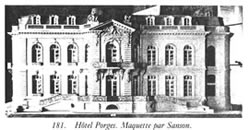
Sanson's sketches and studies gave rise to a preliminary design. After several modifications, a scale model was made under the architect's supervision. On the basis of that model, much further deliberation led to a final choice. When it came to the execution and installation of the sculpted elements, a few last-minute modifications were still introduced. |
The Hôtel Porgès was enclosed by a wall ornamented with rusticated bossage and pierced with broad arched openings as well as two carriage gates that took up the best designs of the 17th or early 18th century, notably those of the Hôtels de Châlons-Luxembourg, Meliaud and Verrue.
The cartouches, firmly drawn, the vigorous corbels, and the carved skin of the Nemean lion placed on the extrados of the round arch, gave these entrances great distinction.
|
For the main building itself, the architect drew close inspiration from the Château d'Asnières, residence of the marquis Marc-René de Voyer d'Argenson — governor of Vincennes, Director-General of the Royal Stud Farms under Louis XV, son of the Minister of War and nephew of the former Minister of Foreign Affairs who was the author of celebrated memoirs. That residence had been built from 1750 onwards by the architect Jacques Hardouin-Mansart de Sagonne, designer of the Saint-Louis de Versailles church and grandson of Jules Hardouin, architect to Louis XIV.
Raised by a few steps, a half-moon avant-corps projected between two wings. The arched ground-floor windows, decorated with mascarons on the keystone of the arch, contrasted with the rectangular ones of the first floor. That fine residence, embellished with sculptures by Guillaume II Coustou, monochrome paintings by Jean-Baptiste Pierre, and panelling executed from designs by Nicolas Pineau (assisted by his son Dominique), formed the setting for a celebrated collection that included several canvases by Rubens, Van Dyck, Rembrandt, Brueghel de Velours and Claude Le Lorrain.
These features could not fail to catch the eye of the Porgès family. They were not alone in being captivated by the pleasing proportions of the Château d'Asnières, since in the 1900s the coal magnate Edward-Julius Berwind had a replica of the building put up at Newport, in the United States of America, by the architect Horace Trumbauer, assisted by the Duveens for the decoration.
An analogy is also to be noted between the Porgès residence and the general lines of the Château de l'Engarran in the Hérault, itself also built in the 18th century.
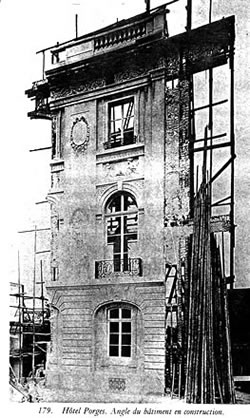
At the Hôtel Porgès, it was decided to pierce the ground floor with openings whose tops were slightly rounded and ornamented with key-stone clasps. On the first floor, tall arched windows displayed mascarons on the keystone.
Above the cornice, a balustrade embellished with groups of putti and vases partially concealed the roof, which was pierced with dormer windows.
The central avant-corps was highlighted by two staircases leading to the garden and by sculpted corbels supporting a wrought-iron-railed balcony. The whole was crowned by a broken pediment enclosing an allegorical high-relief.
The harmony emanating from this façade was the object of much praise.
The main entrance faced the avenue Montaigne.
|
|
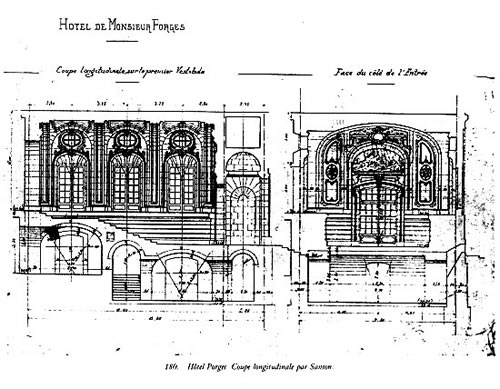
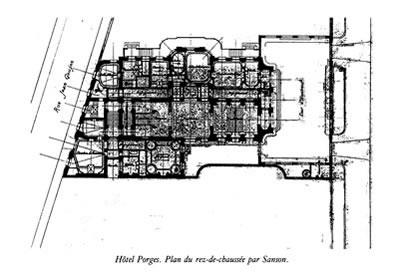
 The architect put forward several proposals for his demanding clients. Initially, an oval-shaped main courtyard was considered, but the architect and the patrons eventually settled on a more classical rectangular design. The entrance led into a first vestibule, also rectangular, and then into a second, square in plan, which preceded the grand staircase — generously proportioned, decorated with marbles and crowned by a dome. The architect put forward several proposals for his demanding clients. Initially, an oval-shaped main courtyard was considered, but the architect and the patrons eventually settled on a more classical rectangular design. The entrance led into a first vestibule, also rectangular, and then into a second, square in plan, which preceded the grand staircase — generously proportioned, decorated with marbles and crowned by a dome.
A concession was made to modernity in that the staircase was paired with a lift. To the left were a billiards room and Jules Porgès's bedroom, while to the right his wife's and daughter's bedrooms were appointed with refined luxury and enjoyed a pleasant view of the garden.
On the first floor, the picture gallery — laid out parallel to the avenue Montaigne — was installed beside the ballroom, facing the garden.
These last arrangements revealed that the Porgès family, like the Castellanes or the Potockis, had demanded a luxurious setting for their receptions. The harmonious proportions and the splendour of the staircases, antechambers, drawing rooms and dining rooms — adorned with decoration drawn essentially from the repertoire fashionable in France during the first quarter of the 18th century — commanded the admiration of their contemporaries. Among the regular visitors to this residence must be mentioned several members of the French aristocracy, such as the Duc de Vendôme, as well as numerous politicians and diplomats.
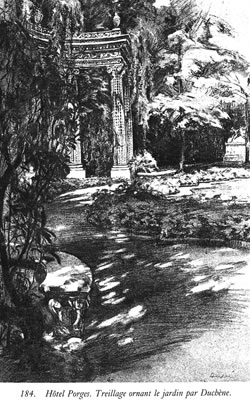
In 1894, the demolition of buildings on the immediately surrounding plots allowed Duchêne to lay out a French-style garden, embellished with a picturesque trelliswork folly that formed a perspective.
At no. 40 rue Jean Goujon, the stables, harness rooms and various staff quarters were erected.
The Porgès residence, which was among Sanson's earliest Parisian works, bears witness to a genuine understanding of the principles of classical architecture adapted to modern comfort. The rooms were not laid out in tedious enfilades; the circulation spaces were carefully studied, while the mezzanines, judiciously placed, eased the movement of the staff.
Sanson declared that this construction had cost 4 million francs.
|
 |
After the death of Mme Jules Porgès, the mansion was sold, and then came the Second World War. During the Occupation the Germans had a blockhouse built in the garden. The mansion was subsequently torn down and replaced by a modern apartment building.
Apart from the town house on the avenue Montaigne, Mme Porgès also owned, at Rochefort-en-Yvelines south-west of Paris, a former property of the Rohan family. There she sought to express her attachment to the creations of 18th-century France even more strongly.
On the summit of a hill — overlooking wooded slopes on one side and a pleasant valley on the other — she commissioned the architect Charles Mewes to build an impressive residence that possessed most of the features of the Hôtel du Prince de Salm, the work of Pierre Rousseau and today the Palais de la Légion d'Honneur, next to the Musée d'Orsay in Paris. At Rochefort-en-Yvelines, the proportions of the model had been doubled.
The Porgès family stood at the meeting point of tastes between classical tradition and certain architectural undertakings on the other side of the Atlantic. After the First World War, the B. de Bretteville-Spreckels family decided to build, on a grandiose site overlooking the city of San Francisco and the Pacific Ocean, a building that was an enlarged copy of the Hôtel de Salm in Paris.
The French architect Henri Guillaume, assisted by his American colleague A. G. Applegarth, built for the 1915 San Francisco International Exposition — facing the Golden Gate, in Lincoln Park — the California Palace of the Legion of Honor, a reproduction of the château at Rochefort-en-Yvelines. |
|
|
|
About the social life of Jules
Porgès and his wife in Paris
Source : Emmanuel Mollot, Rochefort-en-Yvelines (2000)
|  .... ....
I have already told what the soirées of the Austro-Hungarian Embassy were like before 1914, when, in the drawing rooms of the Hôtel Matignon, the most brilliant cavaliers set spinning to the rhythm of the waltz the prettiest women of Paris — and a few heads with them.
No celebration was complete without the Prince of Hohenlohe, the Counts Nemès, Festetics, Tarnowski, Schönborn, Baron Léon de Vaux, Baron Oscar de Gautsch, and Rodolphe de Mittag, an irresistible waltzer who had stolen the heart of one of our great ladies.
The Embassy had in Paris a veritable unofficial annex: the Hôtel Porgès, on the avenue Montaigne. Mme Jules Porgès, who was Viennese, had had built that vast mansion of majestic bearing and uncertain style, whose drawing rooms — as full of old master paintings as the galleries of a museum — served as the setting for many a celebration. She also owned at Rochefort-en-Yvelines a château that was comfortable and sumptuous in the manner of a grand hotel.
Count Khevenhüller, the Austro-Hungarian ambassador, Baron de Vaux, and the secretaries of the Embassy were quite at home on the avenue Montaigne, as was Count Chevreau, whose town house on the rue Monsieur has since become the property of Mme Georges Menier (it is the former mansion of the Count of Jarnac, built on the site of a convent of the Barnabites…).
A brilliant conversationalist, Urbain Chevreau was descended from a minister of Napoleon III, and also from that curious personage who served as secretary of orders to Queen Christina of Sweden and who arranged the marriage of Monsieur, brother of Louis XIV, to Princess Charlotte-Elisabeth.
He made frequent stays in Lausanne, the "Babel of the Gotha," from where he would often send me long letters full of all the gossip of the day.
The Hôtel Porgès had been bought before the war by a company, and the Germans installed themselves there on their arrival in Paris.
In the garden they erected a colossal blockhouse barely lower than the mansion itself, and which has been given up on as too difficult to blow up.
That concrete boulder is beginning, thanks to mosses and lichens, to take on something of a patina.
In the aftermath of the war, Austria, which no longer had an embassy in Paris, acquired a town house on the rue Beaujon for its Legation.
In March 1937 the minister, M. Vollgrüber, gave there a reception in honour of M. Ernst Buschbeck, curator of the Czernin Gallery in Vienna, who had come to give a talk on the Exhibition of Austrian Art at the Jeu de Paume.
M. Vollgrüber left us to become Secretary-General of the Ministry of Foreign Affairs in Vienna.
M. H. D. Schmid, who had been the collaborator of his predecessor at the Legation….
(André
de Fouquières, 50 ans de panache, Éditions
Pierre Horay, p. 314-315) |
|
|  … in which the most famous actors of the day took part: Got, Samson, Geoffroy, Madeleine Brohan, Mme Favart. … in which the most famous actors of the day took part: Got, Samson, Geoffroy, Madeleine Brohan, Mme Favart.
The guests had received programmes bearing the heading: Theatre of Pompeii, reopening after 1,800 years of closure for repairs…
After his marriage to Princess Clotilde of Italy, the son of King Jérôme sold his Pompeian House.
No one was found to take on this thoroughly … imperial fantasy: the central "impluvium" served for a time as the basin of a man with performing seals, and the gawkers trod over the flagstones where the ladies of the Court had once danced their first waltzes, swaying their crinolines.
Then, in 1891 — the very year in which "Plon-Plon" (as the Prince was familiarly known) departed this world in a hotel in Milan — the palace was demolished.
A few remnants, judged worthy of preservation, were transported to the Hôtel de Sully, on the rue Saint-Antoine.
The banker Jules Porgès later commissioned from Samson — the architect favoured at the time by high society — the mansion that was to replace the Pompeian House.
A mansion still to be seen today, but disfigured by the blockhouse the Germans erected there during the Occupation.
Impregnable, that enormous concrete monster could not have been dynamited without endangering the neighbouring residences.
The Hôtel Porgès enjoyed a brilliant period. The lady of the house gave sumptuous celebrations, receiving her guests with infinite graciousness at the top of the magnificent marble staircase.
Everything unfolded according to the rites of a rather pompous ceremony, but whatever these gatherings might have had of the solemn was joyously enlivened by the presence of the ambassador of the Dual Monarchy, Count Khevenhüller — a regular and most charming guest of Mme Porgès — by the young Austro-Hungarian diplomats, all of them incomparable waltzers, and by the family's Spanish friend, the Count of Casa-Sedano, who brought there his good humour and high spirits.
In the course of one of these soirées I led the cotillon with Mme Porgès's daughter, the Marquise de La Ferté-Meun.
After the death of Mme Porgès, the mansion was sold; then came the war.
At the same time as they occupied No. 18, the Germans also installed themselves at No. 20, in the mansion of Mme Edgar Stern, who had assembled there a fine collection of Louis XVI objects and furniture.
Everything was looted.
After the armistice, among the works of art stolen from Mme E. Stern that could be recovered there was found a bust of Sophie Arnould by Houdon.
As a token of gratitude for their recovered treasures, Mme Stern and her children gave it to the Louvre Museum.
Today, these two residences at Nos. 18 and 20 are the property of the Société des Glaces de Saint-Gobain.
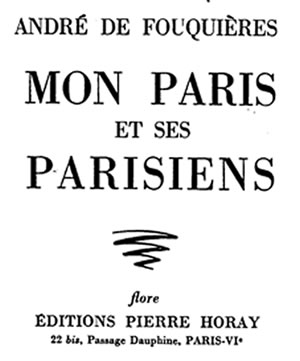
(André
de Fouquières, Mon Paris et ses Parisiens,
Éditions Pierre Horay, p. 84-85) |
|
The Porges diamond
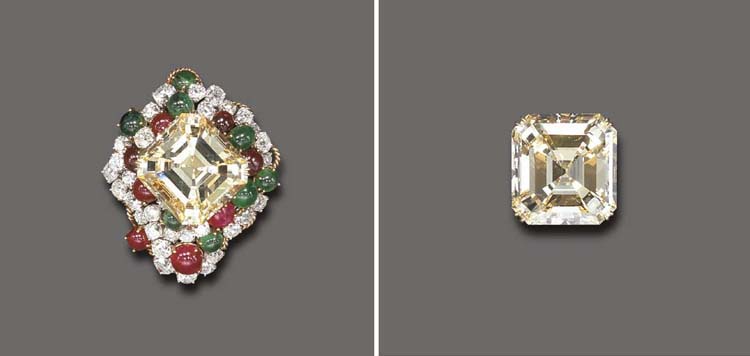
The Porges Diamond is a Fancy Yellow diamond weighing 78.53 carats and was bought by Harry Winston in 1962 who named it, as a tribute to the French diamond mining pioneer, Jules Porges. Winston mounted the stone so that it may be worn either as a brooch, within a frame set with cabochon-cut emeralds and rubies or as a single stone, set within a simple ring mount. The current owner purchased it from Harry Winston directly in 1968 and as record books indicate, the whereabouts were unknown until now.
Jules Porges (1839-1921), descended from a prominent Austro-Hungarian family, was born in Vienna and was raised in Prague, where his father was a master jeweler. By the 1860s he had settled in Paris where he quickly established himself as a principal force in the diamond trade and founded Jules Porges & Company. Just outside Paris, he built a spectacular château in Rochefort-en-Yvelines for his wife and daughter and his residence in Paris was located on the Avenue Montaigne, where he housed an important art collection, focusing on Dutch masters such as Hals and van Dyck. By the time diamonds were discovered in South Africa, he had amassed a tremendous fortune and was considered the leading diamond merchant in the world. Quickly realizing the potential of these newly discovered mines, he dispatched Alfred Beit and Julius Wernher in 1873 to act as his representatives in this new venture and in 1876, Porges himself arrived in Kimberley, playing the unusual role as both consumer and producer of diamonds. Although he had invested in the mining rights of the four major mines (De Beers, Bultfontein, Dutoitspan, and Kimberley), by 1879 he was almost completely focused on Kimberley and had become a close associate of Cecil Rhodes. Rhodes eventually convinced the French investors to sell their shares to the newly formed De Beers firm. Jules Porges quietly retired in 1890.
The Porges is an Asscher-cut Fancy Yellow diamond, SI1 clarity, and it figured as Christie's Magnificent Jewels sale of April 19th and 20th, 2004. It was Lot 473 in Sale 1362, with an estimate of $600,000 to $800,000 US (sold $769.100 US). The brooch in the photo, created by Harry Winston, is set with Old Mine and Old European cut diamonds in a freeform design around the Porges itself. These are enhanced by scattered cabochon-cut rubies and emerald with a total approximate weight of 23.90 and 15.00 carats, respectively. They are mounted in platinum and yellow gold. According to the text of the auction the piece is accompanied by a gold ring mounting and a screwdriver to transfer the Porges Diamond back and forth. Also included was a Harry Winston black suede case.
http://famousdiamonds.tripod.com/porgesdiamond.html
The
paintings collection of Jules Porgès
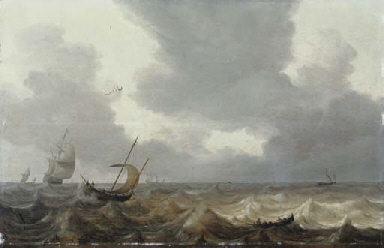
Jan Porcellis
(Ghent 1580/84-1632 Zouterwoude)
A fishing boat and a rowing boat in choppy waters,
a Dutch three-master in the distance remnants of signature
oil on panel 46.1 x 71.4 cm.
Christies Amsterdam, Sale
Date May 17, 2004, Lot Number 99 Sale Number 2623,
Sold : 23.900 €
Provenance : Jules
Porgès, Paris
Anonymous Sale; Cassirer-Helbing, Berlin, 7 December
1926, lot 137, as 'Simon Jacobsz. de Vlieger'.
K.J. Müllenmeister, Solingen. Acquired by the
parents of the present owner in 1974.
Literature
Holländische Meister des XVII. Jahrhunderts
aus der Sammlung Jules Porgès, Paris, illustrated.
K.J. Müllenmeister, Seestücke und Flusslandschaften
niederländischer Maler des 17. Jahrhunderts
in privaten Sammlungen, Bremen, 1973, p. 21, illustrated.
|
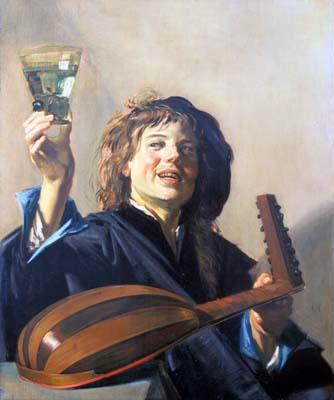
FRANS
HALS 1585-1666
The Merry Lute Player
|
Painted
about 1627. Signed with monogram: F. H.
"One of the happiest inspirations of the artist,
painted with great bravura. It had popular success
even at the time of its execution, as the numerous
old copies of the entire composition, and especially
of the head prove. Jordaens was influenced by it
in his Pair of Merry Lovers" (W. R. Valentiner).
"The history of this painting as given by Hofstede
de Groot (see infra) in reality contains the history
of two pictures, the original and a copy. Owners
of the copy are mentioned as being owners of the
original. Hofstede de Groot himself discovered the
error and noted it in the preface to Vol IV of his
Catalogue, and in the unpublished notes actually
with the Rijksbureau voor Kunsthistorische Documentatie.
The Hague"
(N. S. Trivas).
Panel, 36 x 30 inches.
Lent by the ESTATE OF JOHN R. THOMPSON. Chicago,
Illinois,
COLLECTIONS:
Piecer 'in Capello, Amsterdam, 1767; Count Bonde, Stockholm;
Colnaghi Galleries London;
Jules Porgès Paris;
Baron Ferdinand de Rothschild. Waddeston Manor, England;
Charles Sedelmeyer, Paris;
Edmond Veil-Picard, Paris;
Duveen Brothers, Inc., New York;
Mr. and Mrs. John R. Thompson Chicago, Illinois.
EXHIBITIONS:
Old Masters, Royal Academy, London, 1899, 1929;
Salle du Jeu de Paume, Tuileries, Paris, 1911;
Detroit Institute of Arts, 92. |
|
|
Provenance/Ownership History
:
The sitter's daughter, the comtesse de Neubourg,
later Madame Claude-Christophe Lorimier de
Chamilly;
by descent to the marquise de Pernon;
her daughter, Agathe de Pernon, vicomtesse
de Saint-Pierre, château de Saint-Pierre du Fresne,
Calvados;
by descent to the vicomte de Saint-Pierre, château
de Saint-Pierre du Fresne (probably until d.
1891; sold from his estate to Porgès);
Monsieur
and Madame Jules Porgès, Paris (1891–at least 1910, sold to Wildenstein);
[Wildenstein, Paris and New York, from about 1913; sold to Duveen];
[Duveen,
New York, by 1925–27; sold to Rice];
Mrs. A. Hamilton Rice, New York (1927–29;
sold to Wildenstein);
[Wildenstein, New York, 1929–30; sold to Schuette];
Mrs. Robert W. Schuette, New York (1930–45) |
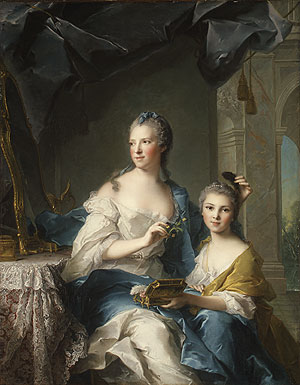
Madame
Marsollier and her Daughter, 1749
Jean-Marc Nattier
(French, 1685–1766)
Oil on canvas;
57 1/2 x 45 in. (146.1 x 114.3 cm)
Bequest of Florence S. Schuette, 1945 |
|
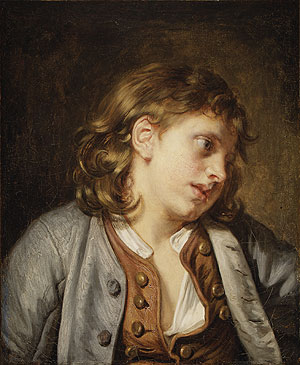
Provenance/Ownership
History
Pierre-Jean Mariette (by 1763–75; his
sale, Basan, Paris, February 1, 1775, no. 24,
17 x 14 pouces, for 1,701 livres to De[s]marets);
[Desmarets, from 1775];
marquis du Blaisel,
Paris (until d. 1870; his estate sale, Hôtel
Drouot, Paris, March 16–17, 1870, no.
54, for Fr 6,100);
Jules Porgès, Paris
(until 1919; sale, Galerie du Vicomte Jacques
de la L . . . et autres provenances, Fièvez,
Brussels, July 3, 1919, no. 34);
[Kleinberger,
New York, 1919];
Michael Friedsam, New York
(1919–d. 1931) |
A Young Peasant Boy
Jean Baptiste Greuze (French, 1725–1805)
The Friedsam Collection,
Bequest of Michael Friedsam,
1931 (32.100.137) |
|
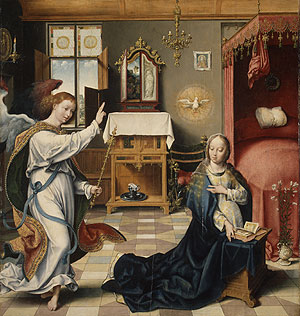
Provenance/Ownership
History
Francis Douce, London (until d. 1834);
Sir
Samuel Rush Meyrick, Goodrich Court, Herefordshire
(1834–d. 1848);
his cousin, Lt. Col.
Augustus Meyrick, Goodrich Court (from 1848);
?his son, Gen. A. W. H. Meyrick, Goodrich Court
(until about 1872);
Mr. W. Twopenny, Woodstock
Park, Sittingbourne;
Mr. B. M. Twopenny (until
1896; sale, Christie's, London, June 20, 1896,
no. 71, as by Martin Schongauer; for £504
to Dowdeswell & Dowdeswell); [Dowdeswell & Dowdeswell,
London, from 1896];
Jules Porgès, Paris
(by 1902–about 1920, as by the Maître
dit de la Mort de Marie or Schongauer);
[Kleinberger,
Paris and New York];
Michael Friedsam, New
York (by 1924–d. 1931) |
The Annunciation, ca.
1525
Joos van Cleve
(Netherlandish, active by 1507,
died 1540/41)
The Friedsam Collection,
Bequest of Michael Friedsam,
1931 (32.100.60) |
|
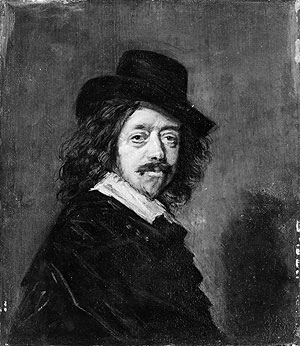
Provenance/Ownership
History
[Édouard Warneck, Paris, in 1878];
L. Goldschmidt, Paris;
Jules Porgès,
Paris (by 1903–at least 1914);
Michael
Friedsam, New York (by 1923–d. 1931) |
Frans Hals (born after
1580, died 1666)
Copy after Frans Hals (Dutch, 17th century)
The Friedsam Collection,
Bequest of Michael Friedsam,
1931 (32.100.8) |
|
|
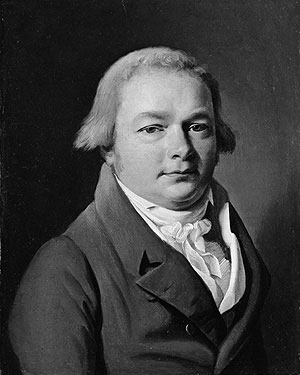
Portrait of a Man
Louis-Léopold Boilly (French, 1761–1845)
Bequest of Harry G. Sperling, 1971 (1976.100.3) |
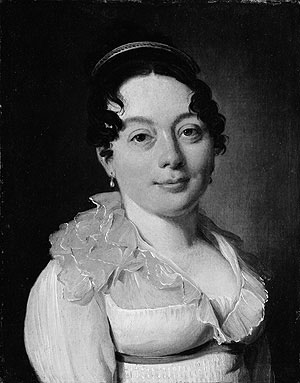
Portrait of
a Woman
Louis-Léopold Boilly (French, 1761–1845)
Bequest of Harry G. Sperling, 1971 (1976.100.2) |
Provenance/Ownership History
Jules Porgès, Paris
[Guy Stein and D'Atri,
Paris, until 1963];
[Kleinberger, New York,
1963–75; bequeathed by Harry G. Sperling,
last surviving partner of firm, to MMA]
|
|
|
|
|
|